
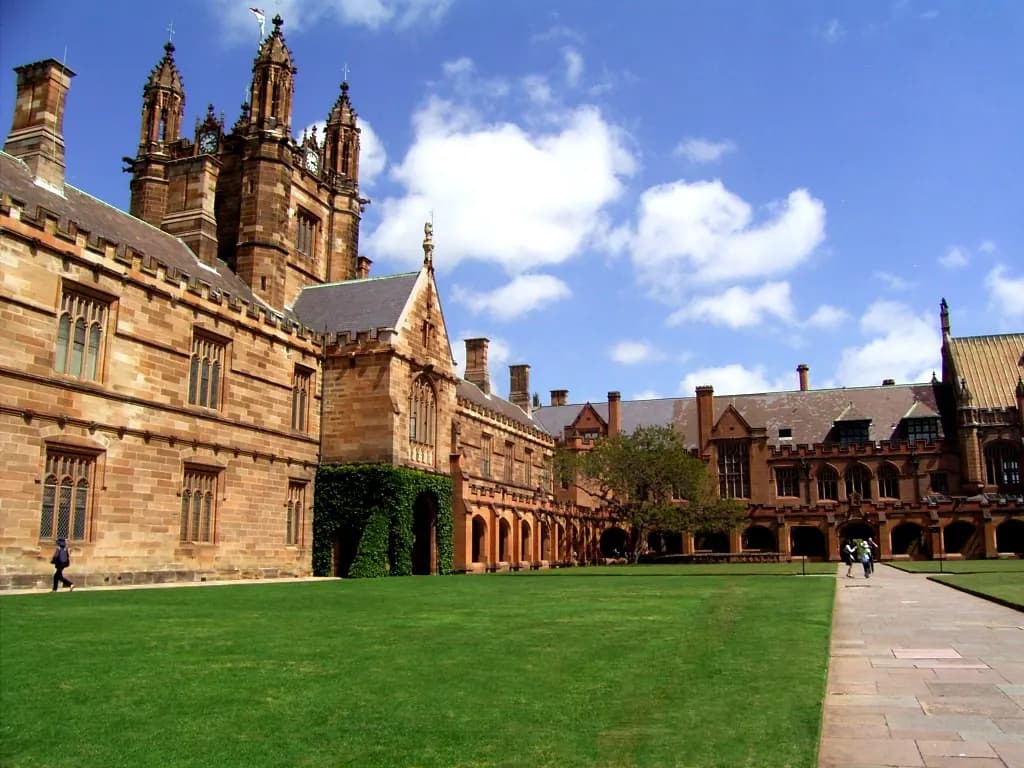
Photo: No machine-readable author provided. KittySaturn~commonswiki assumed (based on c · Public domain
Australia · Sydney, New South Wales
University of Sydney
Australia's first university, in a sandstone quadrangle half an hour from the Opera House
- QS World Ranking 2026
- #18
- Founded
- 1850
- Students
- 73,000
- Bachelor's degree
- 3 years
- Acceptance rate
- Admission by IB score against published thresholds; most programmes admit broadly
- Typical IB offer
- 30–38 points depending on programme, with subject prerequisites
- Language of instruction
- English
Worth knowing
The Main Quadrangle is a Gothic revival sandstone courtyard with turrets and cloisters that is so convincingly medieval it is a standing joke that it looks like Hogwarts; graduations are held in the Great Hall inside it. The Sydney Opera House is about half an hour away on foot and light rail.
How hard is it to get in, and why
Like Melbourne, Sydney publishes an entry score for each course and admits applicants who meet it with the right prerequisite subjects, so the process is mechanical rather than competitive in the American sense. The genuinely hard routes are medicine and dentistry, which combine a very high score with an admissions test and interviews, and a handful of combined law degrees. Everyone else should focus on the published threshold and the subject requirements rather than on building an impressive extracurricular profile.
What it costs
Tuition
$32k–40k per year
International tuition for 2026 runs from about A$50,000 for arts to A$61,000 a year for engineering and science. Converted at about 0.66 dollars to the Australian dollar.
Living costs
$18k–24k per year
Scholarships and financial aid
The Sydney International Student Award offers a fee reduction to high-achieving international applicants, assessed automatically from the application. The Sydney Scholars Awards add competitive named scholarships, and faculty-specific awards exist in engineering, science and business. Full-cost scholarships are rare.
How to apply
Apply directly to the university online for the February or July intake, with rolling assessment rather than a single deadline. You need the published IB score for the course and any prerequisite subjects, and conditional offers on predicted results are standard. Medicine and dentistry require an additional admissions test and interviews; music, design and architecture require auditions or portfolios.
Official websiteWhat makes it special
- Founded in 1850, Sydney is the oldest university in Australia, and its sandstone buildings set the style that later universities copied.
- The open learning environment lets you combine a major from one faculty with a minor from another, including a shared pool of electives.
- Charles Perkins Centre research on obesity, diabetes and cardiovascular disease is among the strongest in the southern hemisphere.
- The campus is in Camperdown, inner-city and walkable, with Newtown's music venues and cafes immediately next door.
- Sydney is expensive, particularly for rent, but beaches are reachable by bus and the climate is mild all year.
About studying in Australia
Three-year degrees, two intakes a year (February and July) and admission by IB score, with programme-specific thresholds. Applications go directly to the university and decisions are usually quick. International tuition at Melbourne and Sydney is around US$30,000 to US$40,000 a year, and bachelor's graduates can stay to work for two years on the Temporary Graduate visa.
Teaching staff
Who runs the university, who teaches, and how lessons actually work.
- Academic staff
- ~3 980
- Nobel laureates affiliated
- 5
- Founded
- 1850
Sydney employs about 3,980 academic staff and nearly 6,000 professional staff for some 70,000 students, and five Nobel laureates and two Crafoord laureates have been associated with it. The vice-chancellor since 2021 is Mark Scott, previously managing director of the Australian Broadcasting Corporation and secretary of the New South Wales education department. Eight academic divisions report to him, each with a dean: Arts and Social Sciences, Science, Engineering, Medicine and Health, the Business School, the Law School, the School of Architecture Design and Planning, and the Conservatorium of Music — the first five holding nearly ninety per cent of the students between them.
Australia's oldest university, founded in 1850, teaches in a way that mixes British inheritance with local practice: lectures followed by tutorials of roughly twenty students, laboratory practicals, and a heavy final examination in many science and law units. Since 2018 every undergraduate degree has included Open Learning Environment units taken outside the home faculty, and shared majors let a student combine, say, engineering with a language. The Dalyell Scholars stream gives high-entry students smaller, more advanced versions of core units. An honours year — a fourth year of supervised research ending in a thesis — remains the standard route into a PhD, and the Faculty of Engineering runs an industry placement requirement of 600 hours before graduation.
Sydney's distinctive institutions are physical. The Charles Perkins Centre, opened in 2014, puts biologists, clinicians, economists and designers in one building to work on obesity, diabetes and cardiovascular disease, with an idea called nutritional geometry — developed there from experiments on locusts — that treats diet as a balance of nutrients rather than a calorie count. The Sydney Nano Institute and the quantum group produced Q-CTRL, the university's first venture-backed spinoff, in 2017. And the sandstone Quadrangle with its Great Hall, begun in 1854, remains the university's working ceremonial centre rather than a museum piece.
Teachers worth knowing
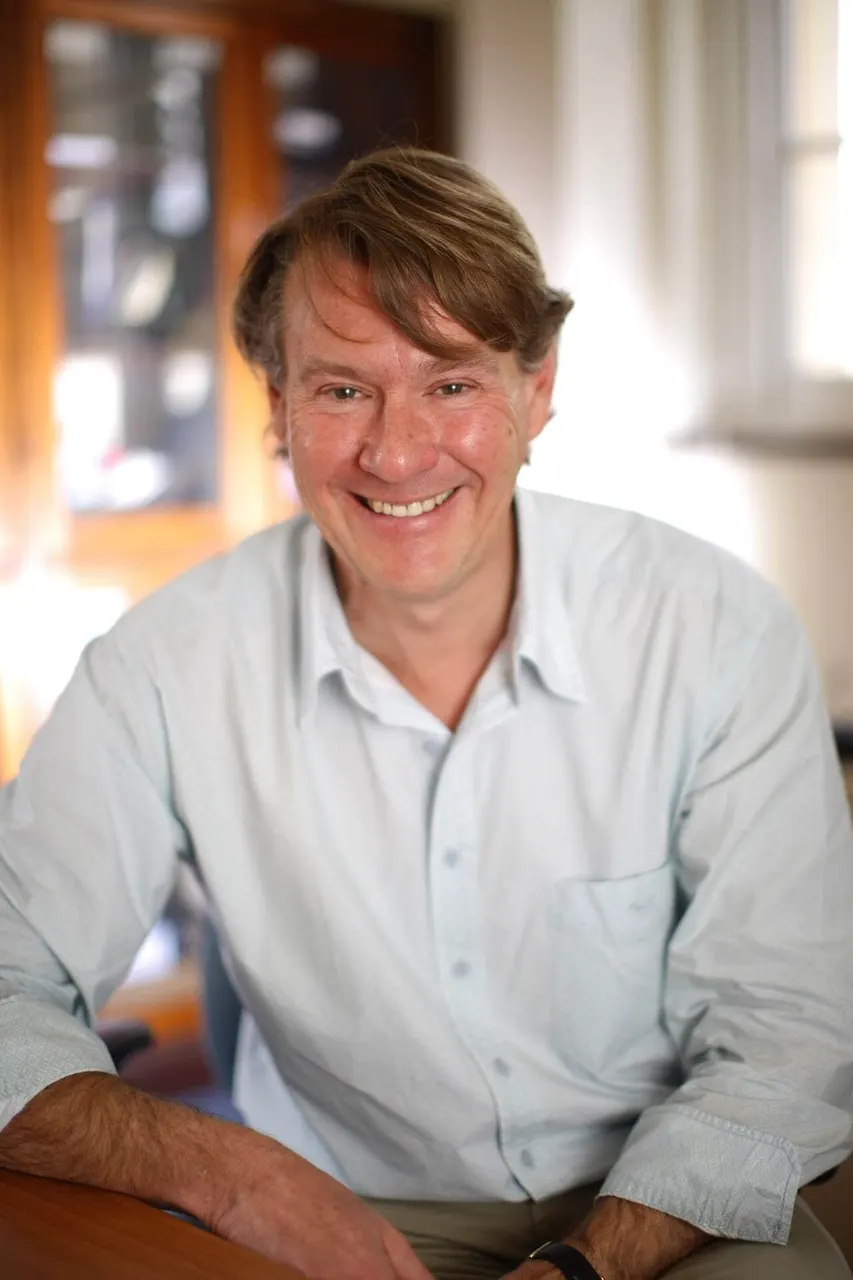 2005–now
Stephen J. Simpson
Professor of Biological Sciences; academic director of the Charles Perkins Centre, 2014–2025
- Teaches
- Nutritional ecology and nutritional geometry · Entomology and insect behaviour
- Experience
- At Sydney since 2005 as an ARC Federation Fellow; founding academic director of the Charles Perkins Centre from 2014 to 2025.
- M2010–now
Michael J. Biercuk
Professor of Quantum Physics and Quantum Technology, School of Physics
- Teaches
- Quantum control and trapped ions · Quantum computing hardware
- Experience
- At Sydney since 2010; founded Q-CTRL in 2017, the university's first venture-backed spinout.
- M2000–now
Marcela Bilek
Professor of Applied Physics and Surface Engineering, School of Physics
- Teaches
- Plasma physics and thin films · Biomedical surface engineering
- Experience
- Professor at Sydney since 2000, appointed at 32 as the first woman professor in the School of Physics; ARC Laureate Fellow 2019.
The campus in photographs
Photographs come from Wikimedia Commons under free licences; the author and licence are shown on each image.
People who studied or taught here
Reviews
No reviews yet. Visited, applied, or studied here? Be the first.