
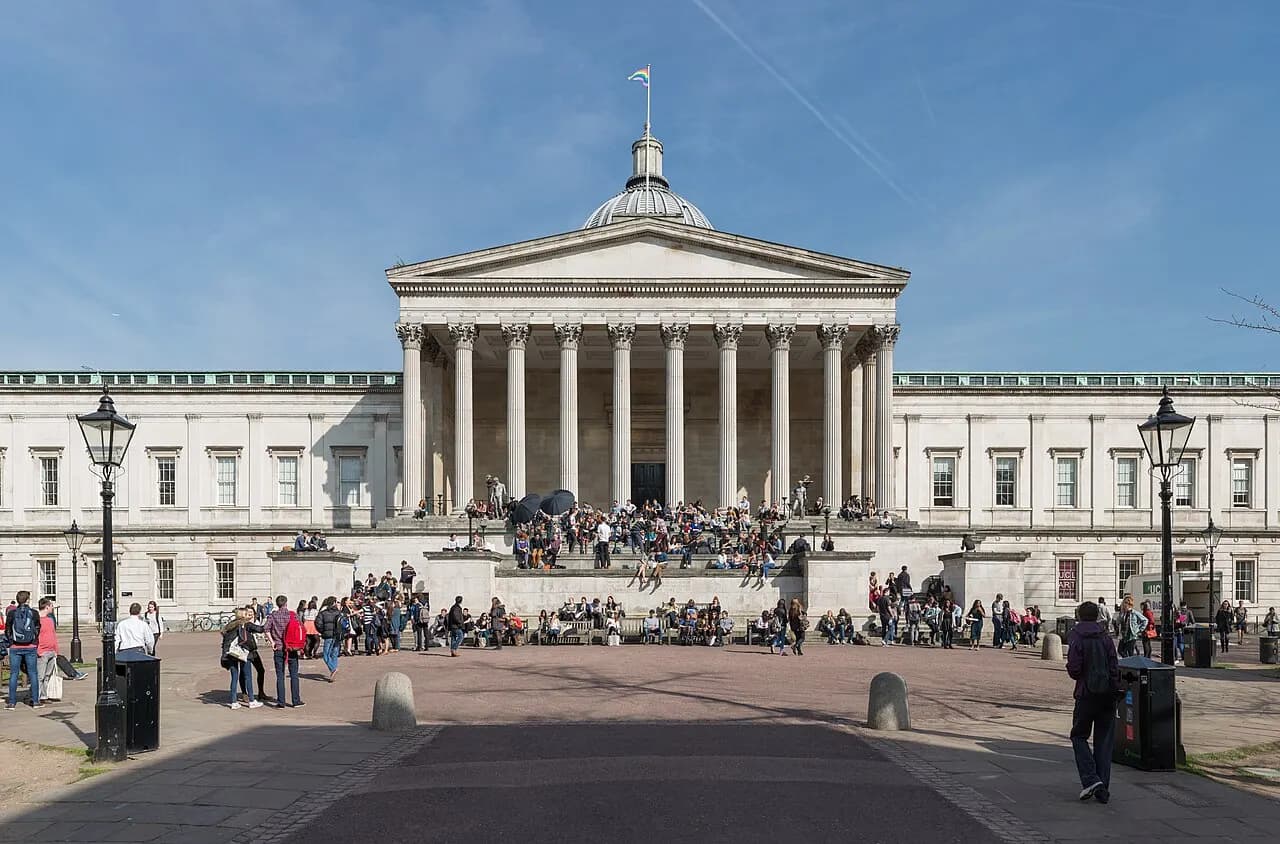
Photo: Diliff · CC BY-SA 3.0
United Kingdom · London, Bloomsbury
University College London
London's first university to admit students of any religion, and now its broadest
- QS World Ranking 2026
- #9
- Founded
- 1826
- Students
- 51,000
- Bachelor's degree
- 3 years
- Acceptance rate
- Around 30% of applicants receive an offer; far lower in medicine and architecture
- Typical IB offer
- 34–39 points depending on programme, with 6/6/6 at Higher Level for the strongest
- Language of instruction
- English
Worth knowing
The philosopher Jeremy Bentham sits in a glass case in the main building. It is the real skeleton, dressed in his own clothes, with a wax head because the preserved one went wrong; he left instructions for it in his will and has been on display since the 1850s. Chris Martin and the rest of Coldplay met as UCL students in halls.
How hard is it to get in, and why
UCL is large and teaches almost everything, so the average acceptance rate looks friendly while individual departments do not. Architecture at the Bartlett, medicine, economics and computer science are as competitive as anything in the country, with portfolios, tests or interviews on top of grades. Everywhere else the decision is made on predicted grades and the personal statement without an interview, which rewards applicants who can show sustained subject interest in writing.
What it costs
Tuition
$38k–68k per year
Overseas fees for 2026 entry run from about £30,000 for arts and social sciences to roughly £53,900 a year for medicine. Converted at about 1.27 dollars to the pound.
Living costs
$22k–28k per year
Scholarships and financial aid
The Global Undergraduate Scholarship supports a small number of international students with demonstrated financial need, covering fees and part of living costs. Departmental awards and the Denys Holland Scholarship add a few more places. As elsewhere in Britain, most international students are self-funded.
How to apply
Apply through UCAS by late January, or by 15 October for medicine. Architecture requires a portfolio, medicine the UCAT and an interview, and a few departments run their own assessments. Most other courses decide on predicted grades and the personal statement alone. UCL sets subject-specific Higher Level requirements and expects mathematics at HL for quantitative degrees.
Official websiteWhat makes it special
- The Bartlett School of Architecture is regularly ranked the best in the world, and its summer show fills the building with experimental structures.
- UCL was founded in 1826 as the first English university to admit students regardless of religion, and the first to admit women on equal terms.
- The campus is in Bloomsbury, next to the British Museum and a short walk from four mainline stations, with the whole city as a study resource.
- Thirty-two Nobel laureates are associated with UCL, including the discovery of the noble gases and work on the structure of DNA.
- It is big: over fifty thousand students, which means enormous choice of societies and modules but less hand-holding than a collegiate university.
About studying in United Kingdom
Three-year degrees in England (four in Scotland), and you apply for one subject rather than for a university in general. UCAS allows five choices, only one of which can be Oxford or Cambridge, with a 15 October deadline for those two and for medicine. Oxbridge adds admissions tests and interviews; IB offers at the top range from 38 to 42. International fees run from about £25,000 to £45,000 a year, need-based aid is scarce, and graduates can stay on to work for a limited period under the Graduate visa.
Teaching staff
Who runs the university, who teaches, and how lessons actually work.
- Student–staff ratio
- 10:1
- Faculties
- 11
- Nobel laureates affiliated
- 32
UCL is the largest of the London colleges, with around 9,000 academic and research staff and some 50,000 students, giving roughly ten students per member of academic staff. Thirty-two Nobel laureates have been associated with it, in physiology, chemistry, physics, economics and literature. Dr Michael Spence, an intellectual property scholar who previously ran Oxford's Social Sciences Division and then the University of Sydney, presides over eleven faculties, each with its own dean: Arts and Humanities, Brain Sciences, the Built Environment, Engineering Sciences, Education and Society, Laws, Life Sciences, Mathematical and Physical Sciences, Medical Sciences, Population Health Sciences, and Social and Historical Sciences.
Teaching is department-led rather than college-led, and each faculty has developed its own rhythm. Engineering runs on scenario weeks, where normal timetables stop and students work in teams on a single industrial problem for five days. Medicine, taught across UCL's associated hospitals, puts students on the wards from the second year. The Bartlett school of architecture works studio-style, with students building and defending projects in front of visiting practitioners rather than sitting examinations. Across the university most undergraduate modules combine lectures with seminars or laboratory sessions, and assessment mixes coursework with examinations far more evenly than at Oxford or Cambridge.
UCL was founded in 1826 as the first English university to admit students regardless of religion, and the first to admit women on equal terms in 1878, which shaped a culture with fewer inherited rituals than its older rivals. Its Institute of Education is consistently the top-ranked education faculty in the world, the Slade School of Fine Art sits inside the same institution as the physics department, and the embalmed body of Jeremy Bentham, whose ideas inspired the founders, sits in a cabinet in the main building where students walk past it daily.
Teachers worth knowing
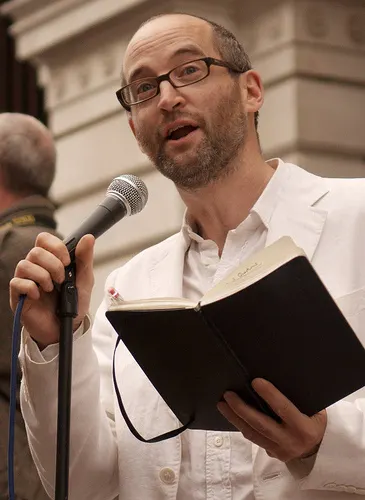 2012–now
Mark Miodownik
Professor of Materials and Society, Director of the Institute of Making
- Teaches
- Materials science · Self-healing and sustainable materials
- Experience
- At UCL since 2012, where he founded the Institute of Making; previously headed the materials research group at King's College London.
- S1976–now
Steve Jones
Emeritus Professor of Genetics, Department of Genetics, Evolution and Environment
- Teaches
- Genetics and evolution · Population genetics of snails
- Experience
- At UCL since the 1970s; headed the Department of Genetics, Evolution and Environment in 1995–1999 and 2008–2010.
- M2021–now
Michael Spence
President and Provost; Professor of Law
- Teaches
- Intellectual property law · Legal theory
- Experience
- President and Provost of UCL since January 2021; previously Vice-Chancellor of the University of Sydney and head of Oxford's Social Sciences Division.
The campus in photographs
Photographs come from Wikimedia Commons under free licences; the author and licence are shown on each image.
People who studied or taught here


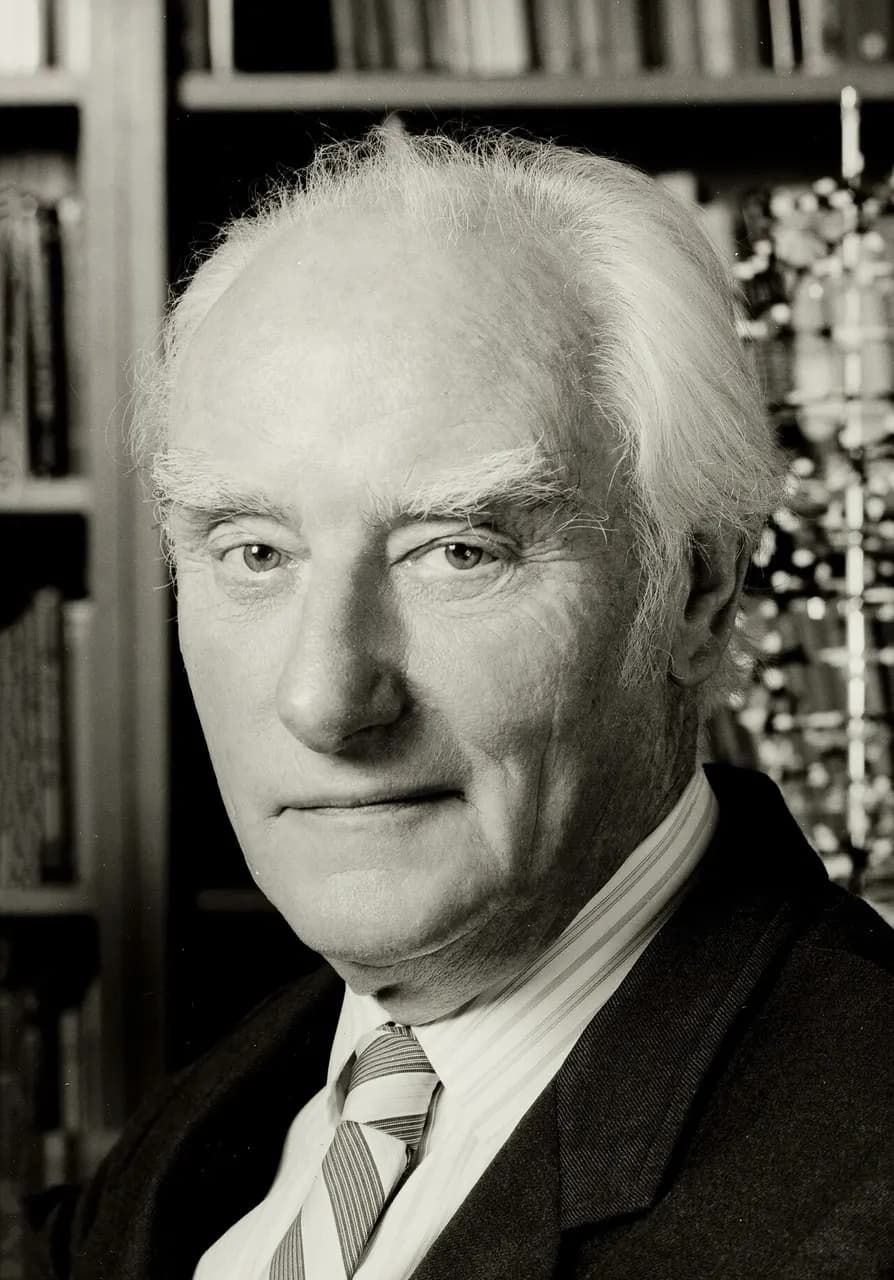 Francis Crick
Molecular biologist, Nobel Prize in Medicine 1962 for the structure of DNA
Graduate · 1934–1937
Reviews
No reviews yet. Visited, applied, or studied here? Be the first.