
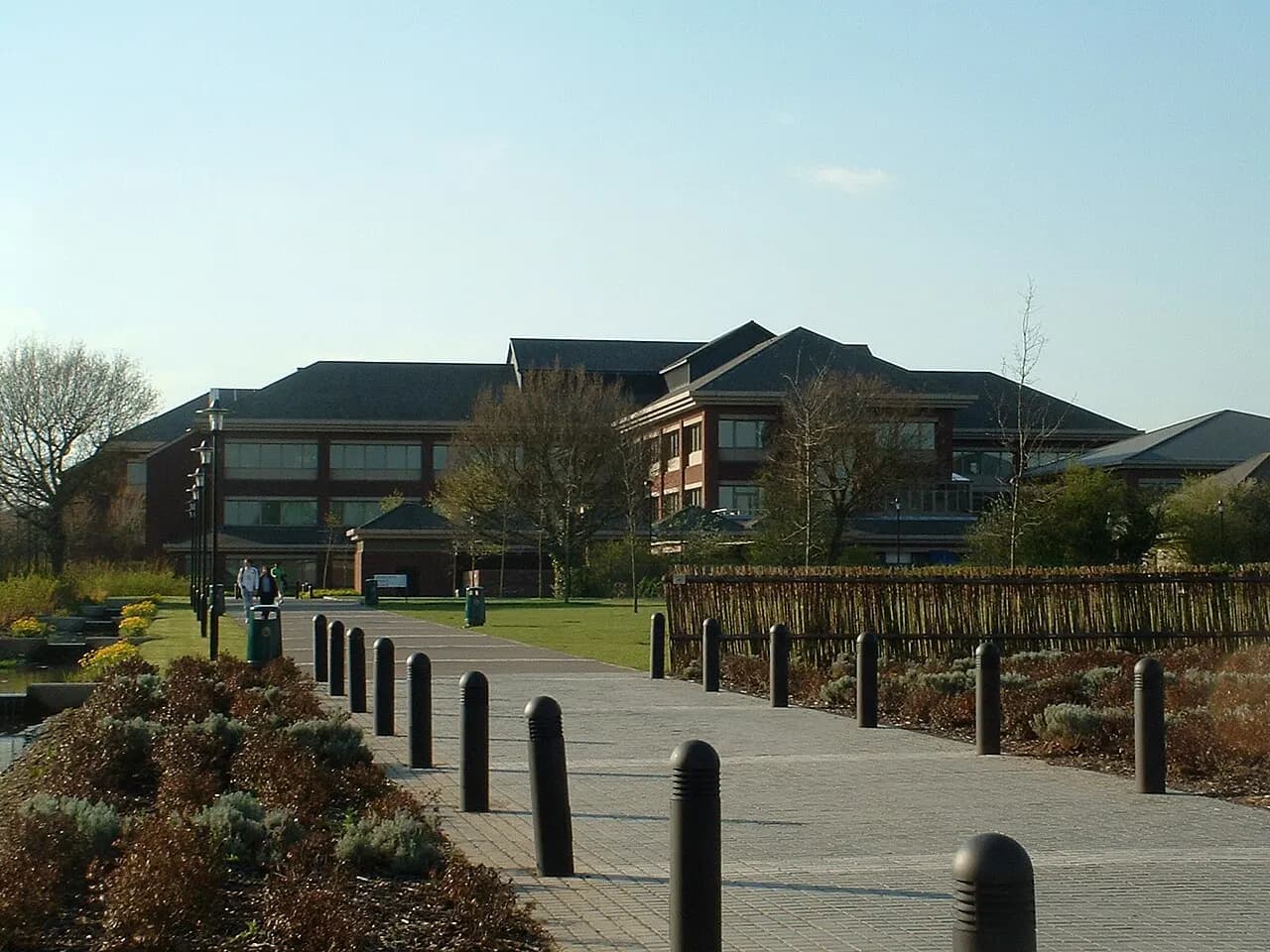
Photo: Wikimedia Commons · CC BY-SA 3.0
United Kingdom · Coventry, West Midlands
University of Warwick
A 1965 campus university that became a powerhouse in maths, economics and business
- QS World Ranking 2026
- #74
- Founded
- 1965
- Students
- 28,000
- Bachelor's degree
- 3 years
- Acceptance rate
- ~60% offer rate
- Typical IB offer
- 36–39
- Language of instruction
- English
Worth knowing
Warwick Arts Centre, right on campus, is one of the largest arts centres in the UK: theatres, a concert hall, a cinema and a gallery that draw about 300,000 visitors a year. Despite the name, the university is not in Warwick at all but on the southern edge of Coventry, a self-contained campus town surrounded by fields, with the county town 15 km away.
How hard is it to get in, and why
About 60% of undergraduate applications received an offer in the 2023/24 cycle, but the departments Warwick is famous for are much tighter: Economics, Computer Science and Warwick Business School make offers to roughly 45–50% of applicants and expect IB 38–39 with 7 in Higher Level Mathematics (Analysis and Approaches only). Computer Science requires the TMUA admissions test; Mathematics uses TMUA or STEP; Economics rewards a strong TMUA with a lower offer. There are no interviews, so the decision rests on predicted grades, subject choice, GCSE-level record and the personal statement. Contextual (reduced) offers apply only to UK applicants.
What it costs
Tuition
$38k–48k per year
2026 entry: Band 1 £27,870 (classroom-based: humanities, most social sciences, law), Band 2 £35,530 (laboratory-based courses plus Mathematics, Statistics, Economics, Computer Science and Warwick Business School). Fees rise by roughly 4–6% a year. Medicine is graduate entry only.
Living costs
$15k–23k per year
Scholarships and financial aid
The Undergraduate Global Excellence Scholarship is the main route: in 2025 Warwick awarded 6 full-fee, 148 half-fee and 103 quarter-fee scholarships plus six one-off £2,000 awards to self-funded international applicants, judged on academic merit. You apply separately by late February after submitting the UCAS application and must hold an offer by mid-May; the scheme covers every subject except Medicine. Beyond this there are only small departmental awards, and no need-based aid for overseas students.
How to apply
Apply through UCAS by 13 January 2027 for 2027 entry (up to five choices, one application to Warwick per subject). The personal statement is the new three-question format, 4,000 characters in total, plus predicted IB grades and a school reference. Warwick does not interview undergraduates, but several courses set tests: Computer Science requires the TMUA (sat in October or November of Year 13), Mathematics asks for TMUA or STEP, and Economics treats a strong TMUA as grounds for a reduced offer. Most courses also want a GCSE-level pass in English and Mathematics, which IB Middle Years or SL results satisfy. Warwick Medical School admits graduates only, so school leavers cannot apply to Medicine here.
Official websiteWhat makes it special
- Founded in 1965 as one of the post-war 'plate-glass' universities; within a generation it joined the Russell Group and is regularly ranked in the UK top ten. The 290-hectare campus has its own lake, sports hub, shops and about 7,000 rooms; from the second year most students rent in Leamington Spa or Coventry.
- Mathematics and Statistics are the signature departments: the MORSE degree (Mathematics, Operational Research, Statistics and Economics) was invented here in 1975 and is now copied worldwide. Economics sits in the UK top three, and Warwick Business School is among the largest and most selective in Europe.
- WMG (Warwick Manufacturing Group) works with Jaguar Land Rover, Tata and Rolls-Royce; the National Automotive Innovation Centre on campus is one of Europe's largest automotive research facilities, and engineering students get placements in it.
- Politics and International Studies (PAIS) is one of the biggest politics departments in the country, and the Law School offers a four-year LLB with a year in Europe.
- Roughly a third of undergraduates come from outside the UK, and the university runs one of the more generous international scholarship schemes in the Russell Group. Birmingham Airport is 30 minutes away and London is an hour by train from Coventry.
About studying in United Kingdom
Three-year degrees in England (four in Scotland), and you apply for one subject rather than for a university in general. UCAS allows five choices, only one of which can be Oxford or Cambridge, with a 15 October deadline for those two and for medicine. Oxbridge adds admissions tests and interviews; IB offers at the top range from 38 to 42. International fees run from about £25,000 to £45,000 a year, need-based aid is scarce, and graduates can stay on to work for a limited period under the Graduate visa.
Teaching staff
Who runs the university, who teaches, and how lessons actually work.
- Student–faculty ratio
- 7:1
- Academic staff
- ~3 800
- Fields Medallists from the Maths Institute
- 2
Warwick employs around 3,800 academic staff for roughly 27,900 students, which works out at about seven or eight students per member of teaching staff. The vice-chancellor, a specialist in international security, presides over three faculties — Arts; Science, Engineering and Medicine; and Social Sciences — containing thirty-two departments, each with its own head, and the faculties themselves are led by pro-vice-chancellors. The Mathematics Institute has produced two Fields Medallists among its former members, Martin Hairer and Richard Borcherds, and the Economics department is consistently ranked in the British top five.
The teaching week is built from lectures plus small-group seminars and, in mathematics and the sciences, supervisions in groups of about five where problem sheets are marked and argued over line by line. Every undergraduate gets a personal tutor from the first week, and departments run their own advisers for module choice. The Undergraduate Research Support Scheme pays students a bursary to spend a summer on a real research project with an academic supervisor, and the results are presented at an annual conference. Assessment is a mix of written examinations in the summer term and coursework, with the final year weighted most heavily in the degree classification.
Warwick's own inventions are unusual for a British university. The Warwick Manufacturing Group, founded in 1980, puts engineering students inside industrial projects with Jaguar Land Rover and Tata, and WMG holds its own degree-awarding programmes. Warwick Business School runs the largest distance-learning MBA in Europe. The campus also houses the Warwick Arts Centre, the biggest such venue outside London, where the Mathematics Institute's regular public lectures and the university's professional theatre programme share a building.
Teachers worth knowing
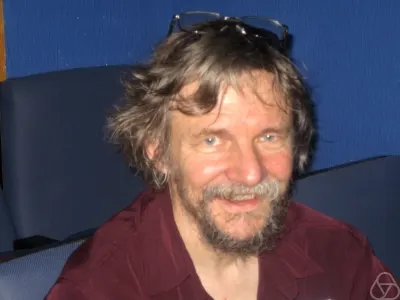 1978–now
Miles Reid
Professor of Mathematics, Mathematics Institute
- Teaches
- Algebraic geometry · Commutative algebra
- Experience
- At Warwick since 1978, professor since 1992; awarded the Royal Society's Sylvester Medal in 2023.
- N1996–now
Nick Chater
Professor of Behavioural Science, Warwick Business School
- Teaches
- Behavioural science and decision-making · Cognition and language
- Experience
- At Warwick since 1996; heads the largest behavioural science group in Europe and advises UK government bodies on behavioural policy.
- A2008–2022
Abhinay Muthoo
Professor of Economics; Head of Department 2008–2016
- Teaches
- Game theory and bargaining · Political economy
- Experience
- Ran Warwick's economics department for eight years, then served as Dean of Warwick in London until 2020.
The campus in photographs
Photographs come from Wikimedia Commons under free licences; the author and licence are shown on each image.
People who studied or taught here



Reviews
No reviews yet. Visited, applied, or studied here? Be the first.