
Physics
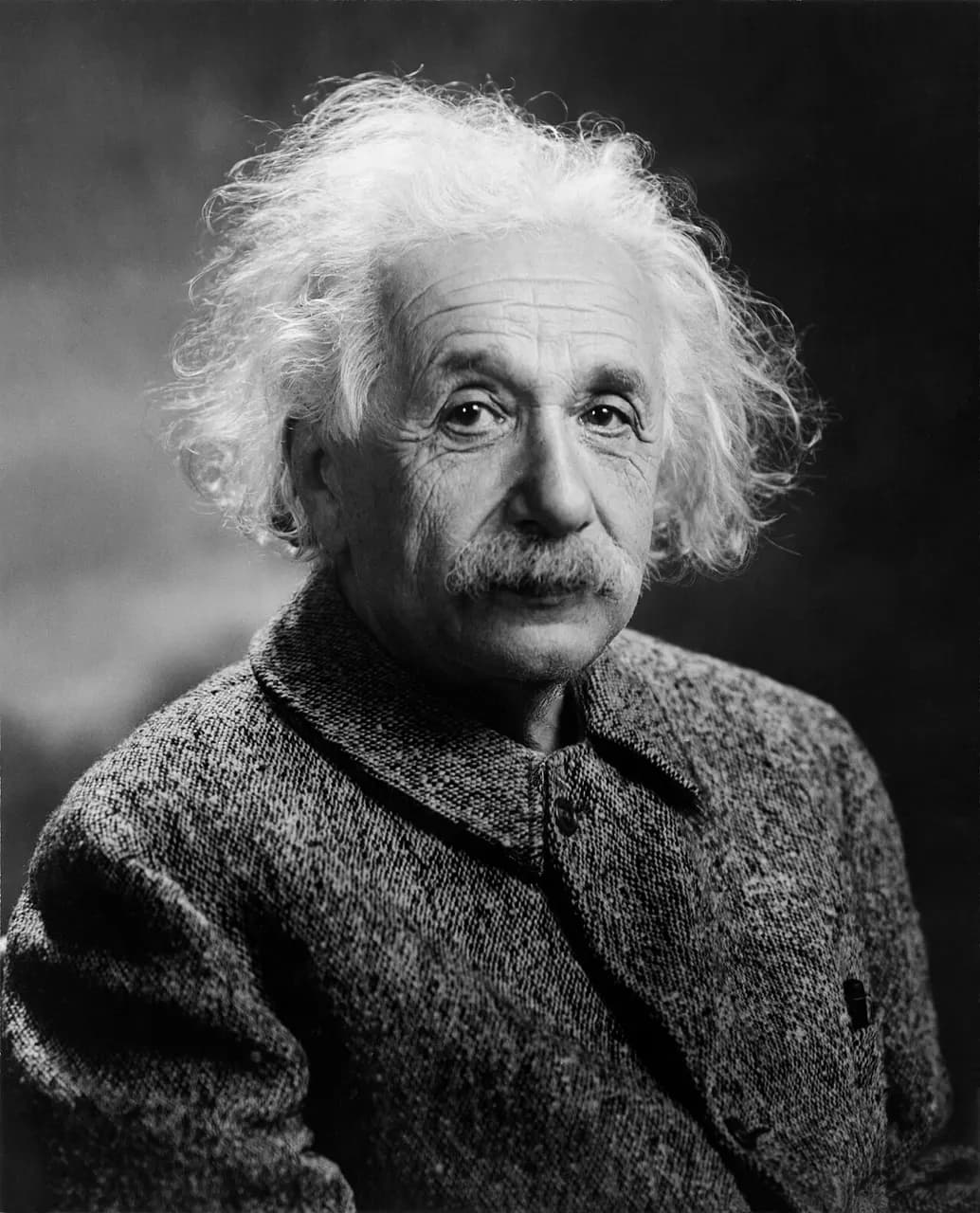
Albert Einstein
Theoretical physicist, Nobel Prize in Physics 1921
Born 1879 · Died 1955
Photo: Oren Jack Turner · Public domain
«Imagination is more important than knowledge. Knowledge is limited. Imagination encircles the world.»
Albert Einstein rewrote physics twice, first with special relativity in 1905 and then with general relativity in 1915, which described gravity as the bending of spacetime. He is the most recognisable scientist who has ever lived.
Key achievements
- Special relativity, 1905, and general relativity, 1915
- Nobel Prize in Physics, 1921, for the photoelectric effect
Universities
Zurich
Studied mathematics and physics from 1896 and took his teaching diploma in 1900; returned as professor of theoretical physics in 1912.
Facts
- He failed the general section of the ETH entrance examination at sixteen, passing the mathematics and physics parts easily, and spent a year at a Swiss school before being admitted.
- He could not find an academic post after graduating and worked for seven years as a patent clerk in Bern, where he wrote his 1905 papers.
- His Nobel Prize was awarded for the photoelectric effect, not relativity, which the committee still considered too speculative.
- He was offered the presidency of Israel in 1952 and declined, saying he lacked the aptitude for dealing with people.
Photographs
Photographs come from Wikimedia Commons under free licences; the author and licence are shown on each image.