
Medicine
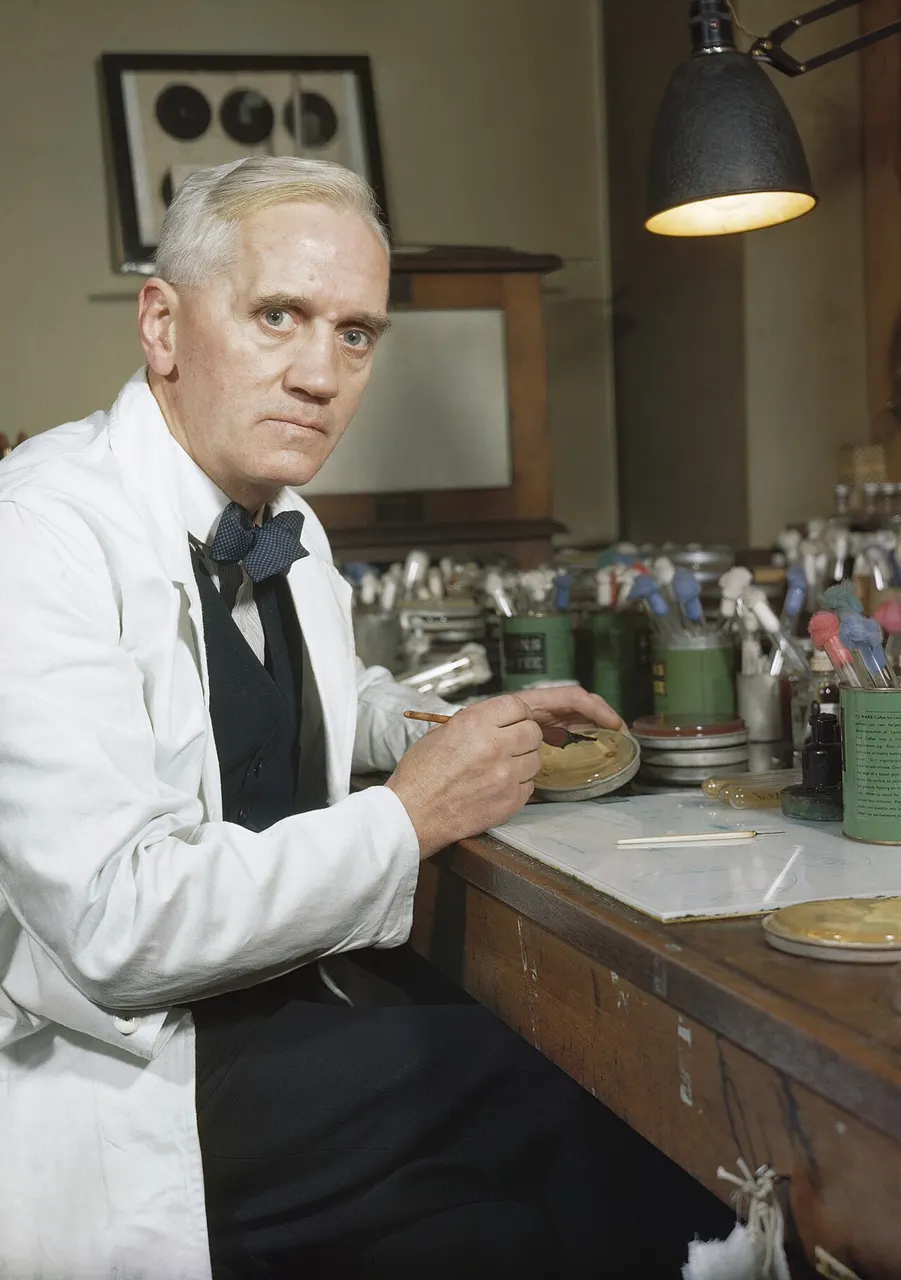
Alexander Fleming
Bacteriologist, Nobel Prize in Medicine 1945 for discovering penicillin
Born 1881 · Died 1955
Photo: Official photographer · Public domain
«One sometimes finds what one is not looking for.»
Alexander Fleming noticed in 1928 that mould contaminating a forgotten culture dish had killed the bacteria around it, and identified the substance as penicillin. Antibiotics have since saved more lives than almost any other medical discovery.
Key achievements
- Discovered penicillin in 1928, opening the antibiotic era
- Nobel Prize in Medicine, 1945, with Florey and Chain
- Warned of antibiotic resistance in his Nobel lecture
Universities
London, South Kensington
Trained and then worked for his whole career at St Mary's Hospital Medical School, now part of Imperial College London.
Facts
- He made the discovery because he went on holiday and left the dish uncovered on a bench; he called it a lucky accident.
- He could not produce penicillin in useful quantities, and it took Howard Florey and Ernst Chain at Oxford a decade to turn it into a medicine.
- In his Nobel lecture he warned that careless use of penicillin would breed resistant bacteria, which is exactly what happened.
Photographs
Photographs come from Wikimedia Commons under free licences; the author and licence are shown on each image.