
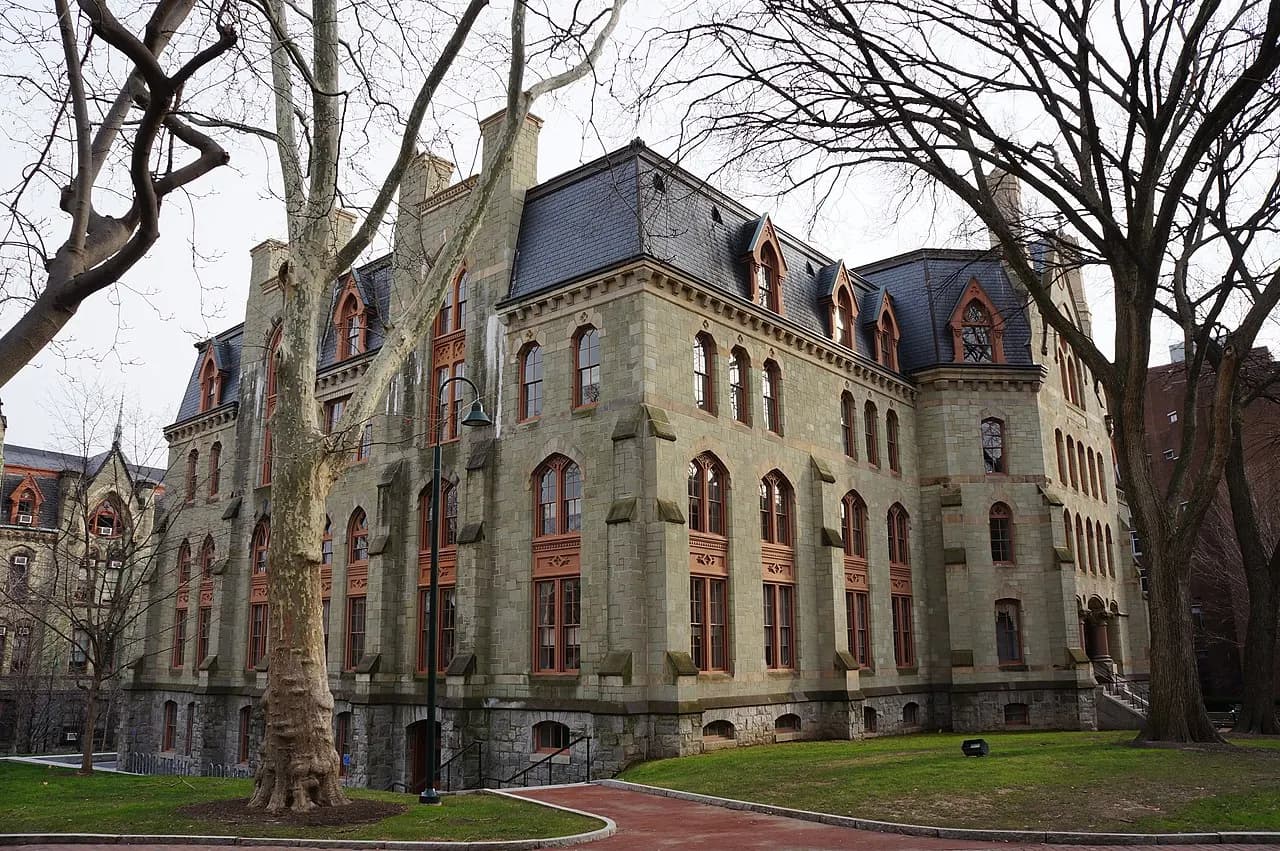
Photo: Michel Alexandre Salim · CC BY-SA 2.0
United States · Philadelphia, Pennsylvania
University of Pennsylvania
Franklin's university: Wharton, Penn Medicine and four schools you can mix freely
- QS World Ranking 2026
- #15
- Founded
- 1740
- Students
- 29,000
- Bachelor's degree
- 4 years
- Acceptance rate
- 5.8%
- Typical IB offer
- 40–44
- Language of instruction
- English
Worth knowing
Penn was founded in 1740 by Benjamin Franklin, the man who flew a kite into a thunderstorm to prove that lightning is electricity. In 1945 its engineers switched on ENIAC, one of the first general-purpose electronic computers: it weighed 27 tonnes, filled an entire room, and part of it still stands in the engineering building.
How hard is it to get in, and why
Penn admitted 5.8% of 61,264 applicants for the Class of 2030, the first year with SAT or ACT scores mandatory again. Wharton and the coordinated dual degrees (Huntsman, M&T, LSM) run well below that average, and international applicants are reviewed need-aware. Roughly half the class is filled in Early Decision, so the Regular round is markedly tougher.
What it costs
Tuition
$66k–74k per year
2026–27 tuition is $65,670 plus $8,308 in fees, identical across the College, Engineering, Wharton and Nursing. Tuition, fees, room and board together come to $94,582.
Living costs
$24k–29k per year
Scholarships and financial aid
Penn is need-blind only for applicants from the US, Canada and Mexico; everyone else is reviewed need-aware. Admitted internationals who applied for aid have their full need met with grants and no loans, and families earning under $200,000 with typical assets receive full tuition scholarships under the Quaker Commitment. There are no merit scholarships.
How to apply
Common App or Coalition; you apply to one of four undergraduate schools (Arts and Sciences, Engineering, Wharton, Nursing) or to a coordinated dual-degree programme. Penn adds three short answers: a thank-you note, a piece on community at Penn and a school-specific question. SAT or ACT is required from the 2026 cycle (hardship waivers exist). Two references, no interviews (the alumni interview programme ended in 2025). Early Decision closes 1 November, Regular Decision 5 January; decisions in mid-December and late March.
Official websiteWhat makes it special
- Wharton, founded in 1881, was the world's first collegiate business school; undergraduates leave with a BS in Economics and the shortest route to Wall Street of any US campus.
- "One University" policy: you may take courses in any of the four undergraduate schools, and coordinated dual degrees pair Wharton with engineering (M&T), international studies (Huntsman) or life sciences (LSM).
- Penn Medicine is where Katalin Karikó and Drew Weissman did the mRNA research that made COVID-19 vaccines possible; they received the 2023 Nobel Prize in Physiology or Medicine.
- Locust Walk threads through a 300-acre campus in West Philadelphia; the airport is 30 minutes away and Amtrak reaches New York in about 80.
- Traditions: toast is hurled onto Franklin Field after the third quarter of home football games; the Penn Relays, the oldest and largest track meet in the US, have run since 1895; juniors wear straw boaters on Hey Day.
- The Penn Museum on campus holds a 13-tonne granite sphinx of Ramesses II, the largest in the Western Hemisphere.
About studying in United States
Four-year degrees and holistic admissions: universities read essays, recommendations and a record of what you have built or led, not only grades. Applications go through the Common App by early November (early rounds) or early January; most top universities have brought back SAT or ACT scores. Sticker prices are the highest in the world, but Harvard, MIT, Yale, Princeton and a few others admit international students without looking at family income and then cover the full demonstrated need.
Teaching staff
Who runs the university, who teaches, and how lessons actually work.
- Student–faculty ratio
- 6:1
- Faculty in total
- ~4 550
- Schools
- 12
Penn has about 2,570 standing faculty and close to 2,000 associated faculty, roughly 4,550 in all, with about six undergraduates per member of teaching staff. The president presides over twelve schools, each with a dean: the School of Arts and Sciences, Wharton, the School of Engineering and Applied Science and the School of Nursing take undergraduates directly, while Medicine, Law, Dental Medicine, Veterinary Medicine, Design, Education, Social Policy and Annenberg are graduate schools whose faculty nonetheless teach undergraduate courses.
The distinctive feature is that the four undergraduate schools share one campus and one course catalogue, so a student admitted to Arts and Sciences can take Wharton finance and an engineer can take a Penn Medicine seminar. Roughly a fifth of undergraduates are in a coordinated dual-degree programme such as Huntsman, Vagelos or the Jerome Fisher Management and Technology programme, which pairs Wharton with Engineering and admits only about fifty students a year. Undergraduate research runs through the Center for Undergraduate Research and Fellowships, and much of Wharton's grading rests on team projects rather than individual examinations.
Penn was founded by Benjamin Franklin in 1740 on the argument that a university should teach useful things as well as classical ones, and the practical streak never left. Wharton, opened in 1881, was the world's first collegiate school of business. The Perelman School of Medicine, founded in 1765, was the first in the American colonies. And it was in a Penn laboratory that Katalin Karikó and Drew Weissman worked out how to modify messenger RNA so the immune system would tolerate it — the discovery behind the COVID-19 vaccines, which won the 2023 Nobel Prize in Medicine.
Teachers worth knowing
 2009–now
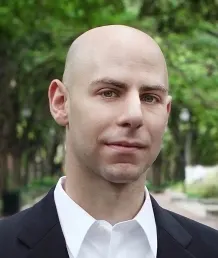
Adam Grant
Saul P. Steinberg Professor of Management and Professor of Psychology, Wharton School
- Teaches
- Organisational psychology · Motivation and workplace design
- Experience
- At Wharton since 2009; became its youngest tenured professor and its top-rated teacher for seven consecutive years.
The hallmark of expertise is no longer how much you know. It's how well you think.
More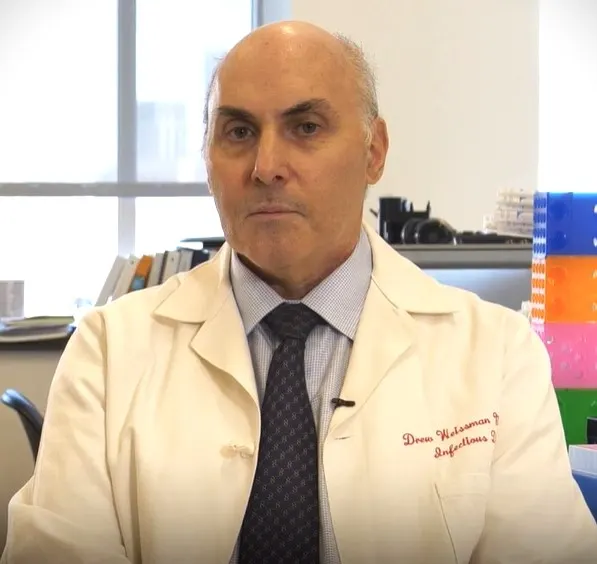 1997–now
Drew Weissman
Roberts Family Professor in Vaccine Research, Perelman School of Medicine
- Teaches
- RNA biology and immunology · Vaccine development
- Experience
- At Penn since 1997; shared the 2023 Nobel Prize in Medicine for the nucleoside modifications behind mRNA vaccines.
We had a lot of trouble getting people to notice RNA as a therapeutic. We got no grants, no papers, no collaborations.
More 1999–now
Carl H. June
Richard W. Vague Professor in Immunotherapy, Director of the Center for Cellular Immunotherapies
- Teaches
- Cancer immunotherapy · T-cell engineering
- Experience
- At Penn since 1999; led the first CAR-T cell trial in 2010 and the first FDA approval of the therapy in 2017.
This is the first time we have taken a patient's own cells, re-engineered them, and used them as a drug.
More
The campus in photographs
Photographs come from Wikimedia Commons under free licences; the author and licence are shown on each image.
People who studied or taught here
Reviews
No reviews yet. Visited, applied, or studied here? Be the first.