
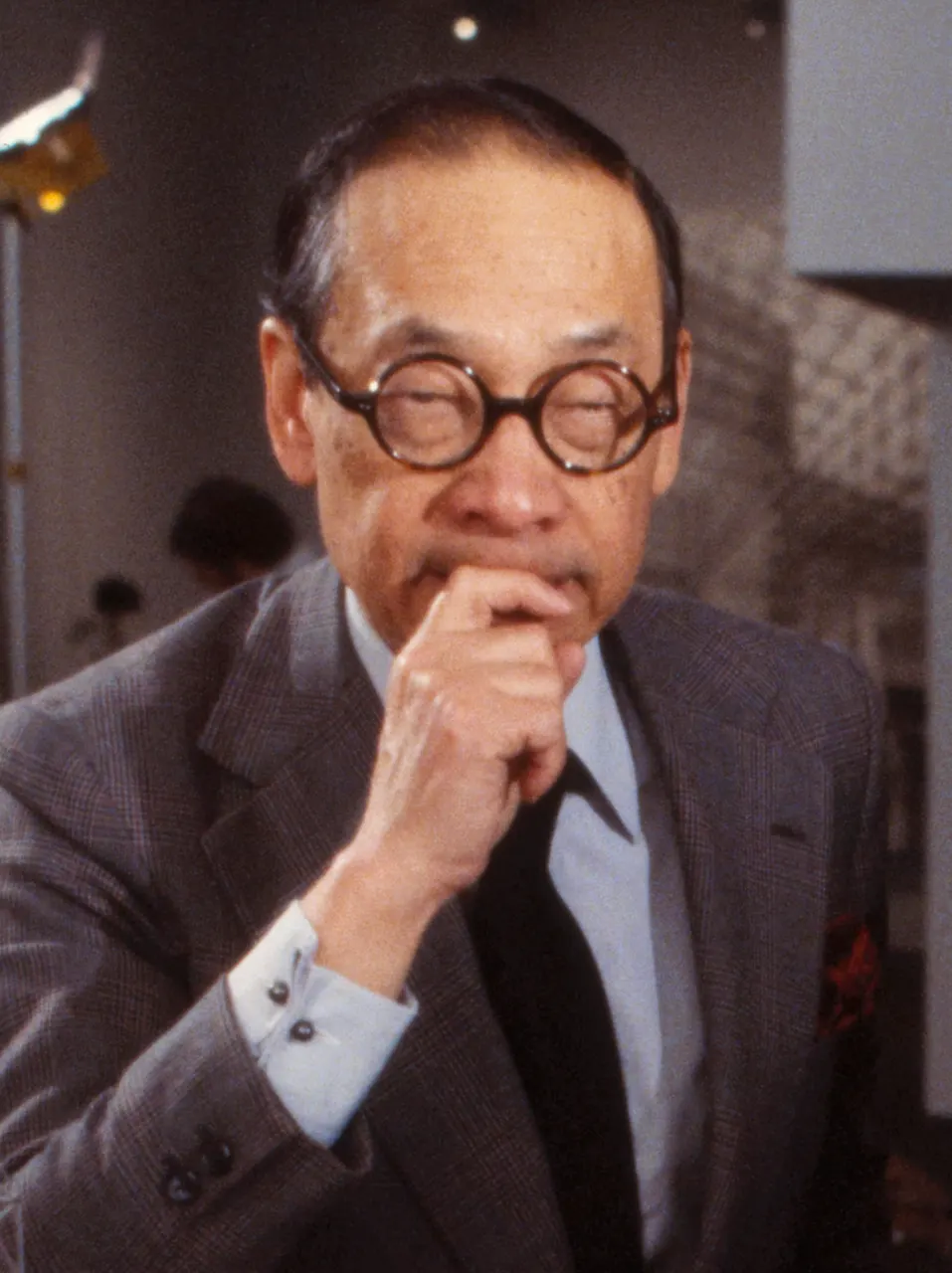
I. M. Pei
Architect of the Louvre Pyramid, Pritzker Prize 1983
Born 1917 · Died 2019
Photo: Bernard Gotfryd · Public domain
«Architecture is the very mirror of life. You only have to cast your eyes on buildings to feel the presence of the past.»
I. M. Pei, born in Guangzhou and educated in the United States, designed the glass pyramid at the Louvre, the East Building of the National Gallery in Washington and the Bank of China Tower in Hong Kong. He won the Pritzker Prize in 1983 and was still completing major buildings in his nineties.
Key achievements
- Pritzker Architecture Prize, 1983
- Designed the Louvre Pyramid, opened 1989
- Built the Bank of China Tower in Hong Kong, 1990
Universities
Cambridge, Massachusetts
Bachelor of Architecture, 1940; discovered Le Corbusier in the MIT library and met him on campus in 1935.
Cambridge, Massachusetts
Master of Architecture at the Graduate School of Design, 1946, under Walter Gropius and Marcel Breuer.
Philadelphia, Pennsylvania
Enrolled in architecture in 1935 but transferred to MIT within weeks, doubting his drawing skills.
Facts
- He sailed to the US in 1935 at 17, enrolled at Penn, then moved to MIT within weeks because he thought his drawing was inadequate; the MIT dean tried to steer him into engineering.
- Le Corbusier's two-day visit to MIT in November 1935 was, Pei said, the most important moment of his architectural education.
- The Louvre Pyramid was condemned by Parisian critics as a desecration before it opened in 1989; today it is one of the city's symbols.
- At 91 he completed the Museum of Islamic Art in Doha, having spent six months travelling through the Islamic world to prepare for the design.
Photographs
Photographs come from Wikimedia Commons under free licences; the author and licence are shown on each image.