
Physics
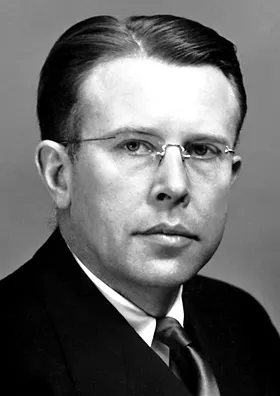
Ernest Lawrence
Physicist, Nobel Prize in Physics 1939 for inventing the cyclotron
Born 1901 · Died 1958
Photo: Nobel foundation · Public domain
Ernest Lawrence invented the cyclotron, a machine that accelerates particles in a spiral so they can be smashed into atoms, and with it created the field of big-machine physics. Two chemical elements are named after him and his university.
Key achievements
- Nobel Prize in Physics, 1939, for inventing the cyclotron
- Founded what is now Lawrence Berkeley National Laboratory
- Element 103, lawrencium, is named after him
Universities
Berkeley, California
Professor of physics from 1928 and founder of the radiation laboratory that became Lawrence Berkeley National Laboratory.
New Haven, Connecticut
Took his PhD in physics in 1925 and taught there before moving to California.
Facts
- His first cyclotron was about ten centimetres across and cost twenty-five dollars in parts.
- Element 103, lawrencium, is named after him, and element 97, berkelium, after his university.
- Berkeley scientists using his machines discovered sixteen chemical elements, including plutonium and californium.
Photographs
Photographs come from Wikimedia Commons under free licences; the author and licence are shown on each image.