
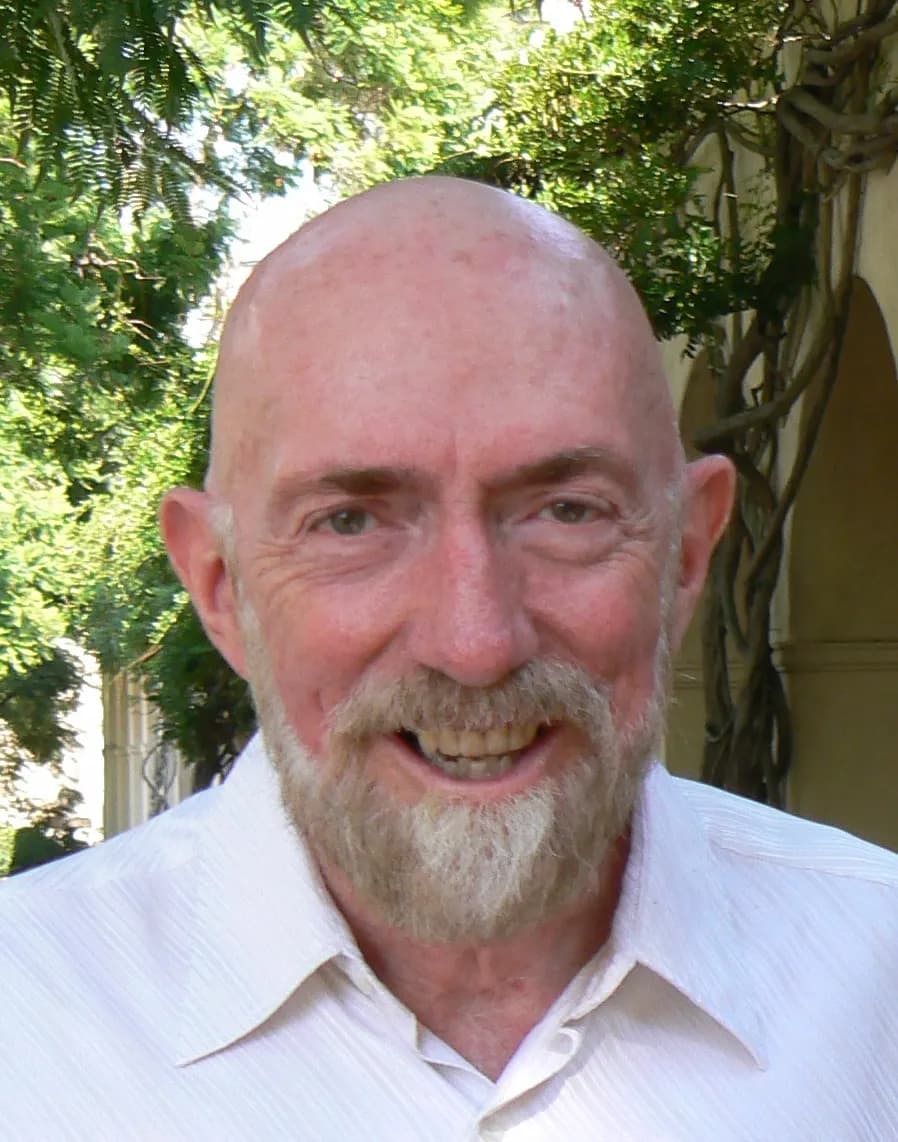
Kip Thorne
Theoretical physicist, Nobel Prize in Physics 2017 for detecting gravitational waves
Born 1940
Photo: Keenan Pepper · CC BY-SA 3.0
«With this discovery, we humans are embarking on a marvelous new quest: to explore the warped side of the universe.»
Kip Thorne spent forty years arguing that ripples in spacetime could be measured, and in 2015 the LIGO detectors he helped design recorded two black holes colliding a billion light years away. He shared the Nobel Prize in Physics two years later.
Key achievements
- Nobel Prize in Physics, 2017, for detecting gravitational waves
- Co-founded the LIGO project
- Scientific adviser and executive producer of Interstellar
Universities
Pasadena, California
Professor of theoretical physics from 1967, and one of the founders of the LIGO project.
Princeton, New Jersey
Took his PhD in 1965 under John Wheeler, the physicist who popularised the term black hole.
Facts
- He was the scientific adviser and an executive producer on the film Interstellar, and the black hole in it was rendered from his equations.
- He became one of Caltech's youngest ever full professors at the age of thirty.
- He has made a habit of betting colleagues on physics questions, and famously lost a bet to Stephen Hawking about whether Cygnus X-1 was a black hole.
Photographs
Photographs come from Wikimedia Commons under free licences; the author and licence are shown on each image.