
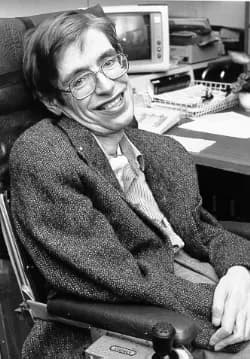
Stephen Hawking
Theoretical physicist, author of A Brief History of Time
Born 1942 · Died 2018
Photo: NASA · Public domain
«However difficult life may seem, there is always something you can do and succeed at. Where there's life, there's hope.»
Stephen Hawking showed that black holes are not entirely black but slowly radiate away, a result that linked gravity, quantum mechanics and thermodynamics for the first time. Diagnosed with motor neurone disease at twenty-one and given a few years to live, he worked for fifty-five more.
Key achievements
- Discovered Hawking radiation, showing black holes evaporate
- Lucasian Professor of Mathematics at Cambridge, 1979–2009
- A Brief History of Time sold over 25 million copies
Universities
Oxford, England
Read physics at University College from 1959, arriving at seventeen, and took a first-class degree in 1962.
Cambridge, England
Took his PhD in 1966 and held the Lucasian Chair of Mathematics, Newton's old post, from 1979 to 2009.
Facts
- He estimated he did about a thousand hours of work in three years at Oxford, and later called his attitude there typical of the time.
- He coxed a college rowing crew, which made him popular but had a reputation for taking risky lines that damaged boats.
- His viva at Oxford was borderline, and he was told that a first would send him to Cambridge while a second would keep him at Oxford; he got the first.
- A Brief History of Time sold more than 25 million copies and stayed on the Sunday Times bestseller list for 237 weeks.
Photographs
Photographs come from Wikimedia Commons under free licences; the author and licence are shown on each image.