
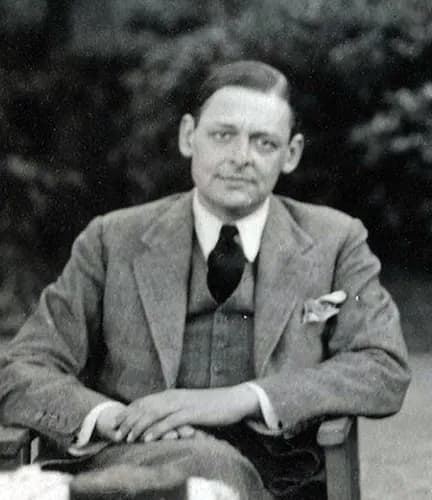
T. S. Eliot
Poet, Nobel Prize in Literature 1948
Born 1888 · Died 1965
Photo: Thomas Stearns Eliot with his sister and his cousin by Lady Ottoline Morrell.jpg · Public domain
«April is the cruellest month.»
T. S. Eliot was the central poet of English-language modernism: The Waste Land (1922) redefined what a poem could be, and Four Quartets is regarded as his masterpiece. Born in St Louis, he became a British subject in 1927, won the Nobel Prize in 1948, and his book of cat poems became the musical Cats.
Key achievements
- Nobel Prize in Literature, 1948
- Wrote The Waste Land, 1922, and Four Quartets, 1943
- His cat poems became the musical Cats, 1981
Universities
Cambridge, Massachusetts
AB in 1909 after three years and AM in English literature in 1910; began a philosophy PhD in 1911 and wrote the dissertation but never returned to defend it.
Oxford, England
Spent 1914–15 at Merton College on a Harvard fellowship, reading Aristotle; took no Oxford degree and stayed in England.
Facts
- He finished his Harvard AB in three years and, while a graduate student, wrote The Love Song of J. Alfred Prufrock, which was published in 1915.
- He completed a Harvard doctoral dissertation on the philosopher F. H. Bradley in 1916 but, having settled in England, never returned to sit the oral examination, so the PhD was never awarded.
- He found Merton College dull, writing to a friend that Oxford is very pretty, but I don't like to be dead; within a year he had married Vivienne Haigh-Wood and settled in London.
- Old Possum's Book of Practical Cats (1939), written for his godchildren, became Andrew Lloyd Webber's musical Cats (1981), one of the longest-running shows in West End history.
Photographs
Photographs come from Wikimedia Commons under free licences; the author and licence are shown on each image.