
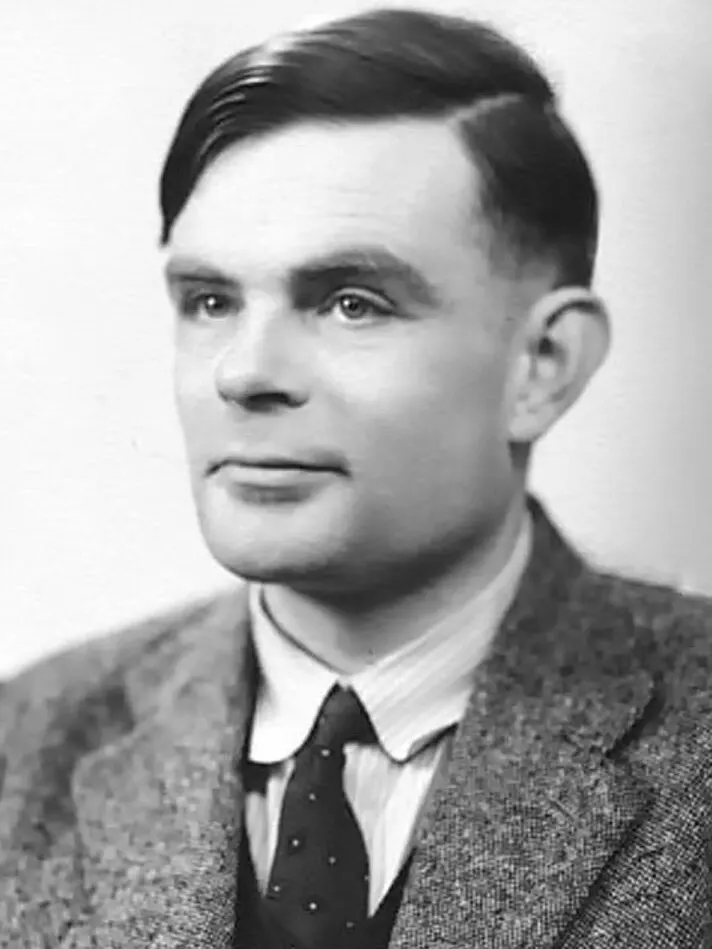
Alan Turing
Mathematician, founder of computer science and Enigma codebreaker
Born 1912 · Died 1954
Photo: Elliott & Fry · Public domain
«We can only see a short distance ahead, but we can see plenty there that needs to be done.»
Alan Turing described in 1936 an imaginary machine that could compute anything computable, and in doing so defined what a computer is. During the war he led the team at Bletchley Park that broke the German naval Enigma cipher, work credited with shortening the conflict by years.
Key achievements
- Defined the Turing machine, the basis of computer science
- Broke the German Enigma cipher at Bletchley Park
- Proposed the Turing test for machine intelligence, 1950
Universities
Princeton, New Jersey
Took his PhD in mathematical logic in 1938 under Alonzo Church, and turned down a job offer from John von Neumann to return to Britain.
Cambridge, England
Studied mathematics at King's College from 1931 and was elected a fellow at 22 for his work on probability.
Manchester
Worked on the Manchester Mark 1, one of the first stored-program computers, from 1948.
Facts
- At Princeton he built part of an electromechanical cipher machine himself in the physics department machine shop.
- He was a serious long-distance runner and once ran the 40 miles from Bletchley to London for a meeting rather than take the train.
- He proposed the test that bears his name: if you cannot tell from a conversation whether you are talking to a machine or a person, the question of whether it thinks is not a useful one.
- Convicted in 1952 under laws criminalising homosexuality, he received a royal pardon in 2013 and now appears on the Bank of England fifty-pound note.
Photographs
Photographs come from Wikimedia Commons under free licences; the author and licence are shown on each image.