
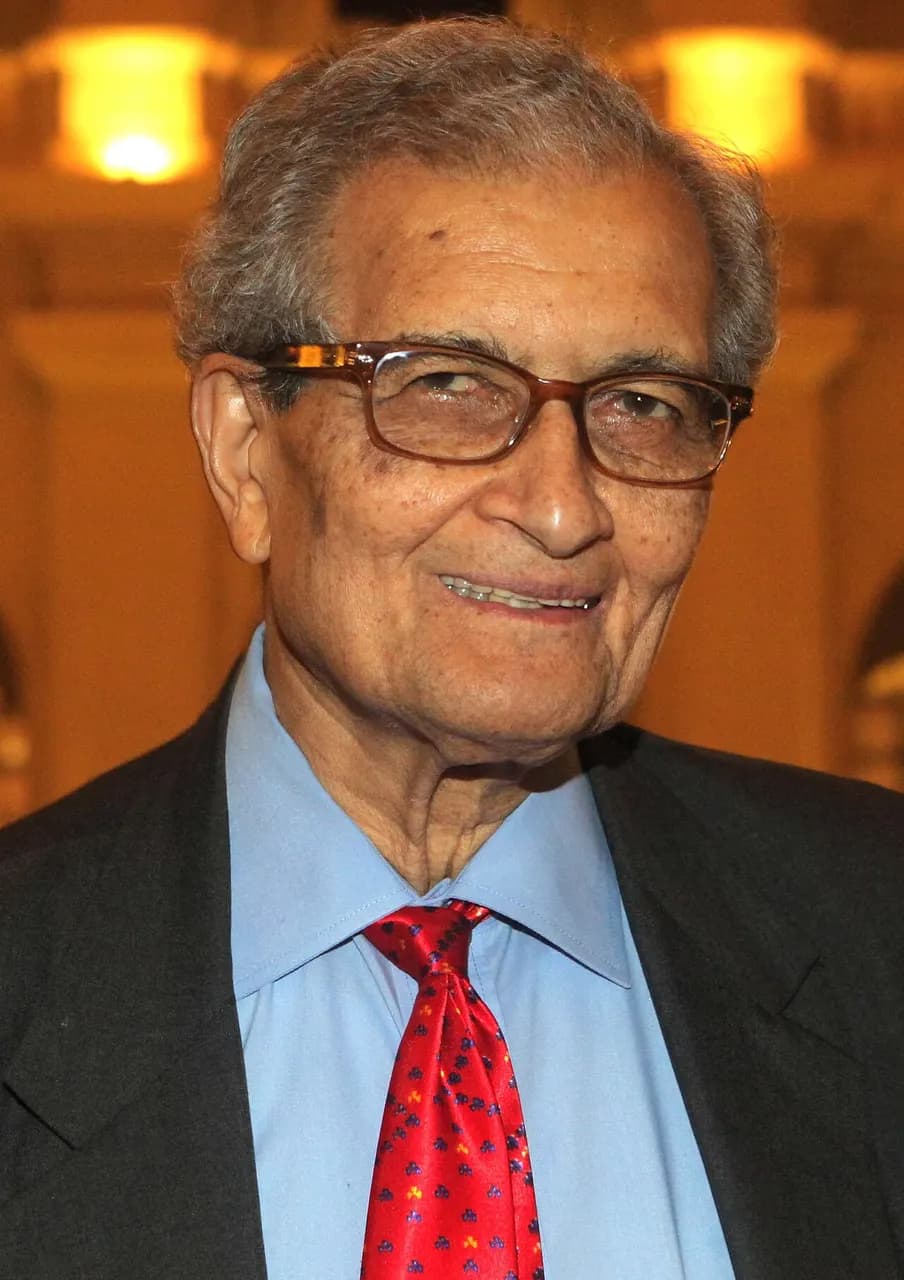
Amartya Sen
Economist and philosopher, Nobel Prize in Economics 1998
Born 1933
Photo: Fronteiras do Pensamento · CC BY-SA 2.0
«Development can be seen as a process of expanding the real freedoms that people enjoy.»
Amartya Sen showed that famines are usually caused not by a shortage of food but by people losing the ability to buy it, and that no famine has occurred in a functioning democracy with a free press. His work reshaped how development and poverty are measured.
Key achievements
- Nobel Prize in Economics, 1998, for welfare economics
- Showed famines happen in democracies almost never
- Co-created the UN Human Development Index
Universities
London, Holborn
Professor of economics at LSE from 1971 to 1977.
Cambridge, England
Took his PhD at Trinity College in 1959 and later returned as Master of Trinity from 1998 to 2004.
Cambridge, Massachusetts
Professor of economics and philosophy, where he has taught for much of his later career.
Facts
- He witnessed the Bengal famine of 1943 as a nine-year-old, and it shaped his entire research career.
- He helped create the Human Development Index, which measures countries by health and education as well as income.
- He was diagnosed with oral cancer at eighteen and treated himself with radiation he researched in a library, surviving against poor odds.
Photographs
Photographs come from Wikimedia Commons under free licences; the author and licence are shown on each image.