
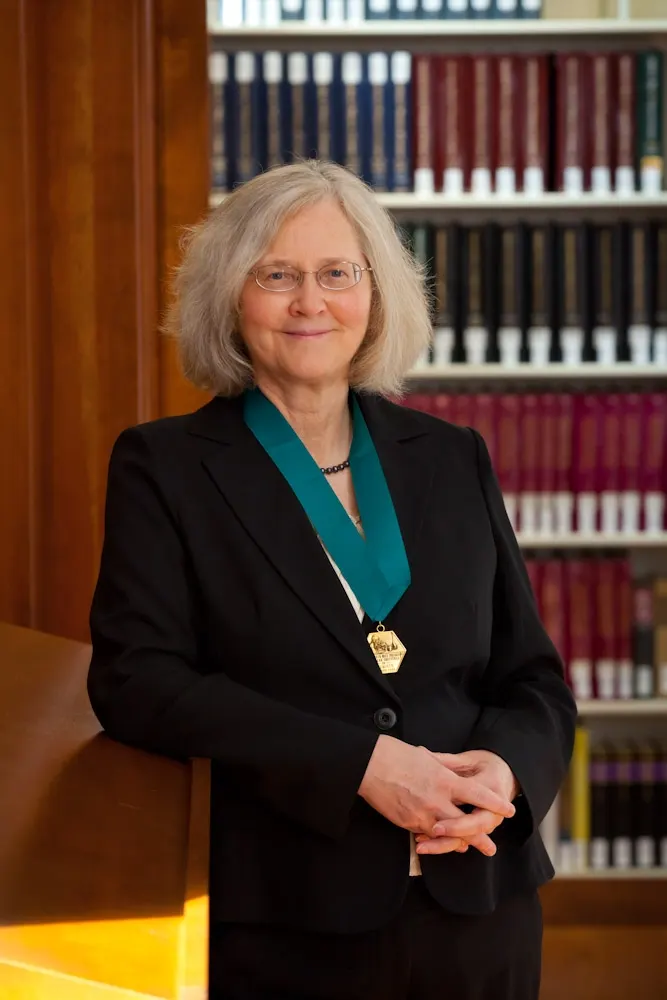
Elizabeth Blackburn
Molecular biologist, Nobel Prize in Medicine 2009 for telomeres
Born 1948
Photo: Conrad Erb · CC BY-SA 3.0
Elizabeth Blackburn discovered telomeres, the protective caps on the ends of chromosomes, and the enzyme telomerase that rebuilds them. The work is central to understanding both ageing and cancer.
Key achievements
- Nobel Prize in Medicine, 2009, for discovering telomerase
- Discovered the enzyme with her student Carol Greider
- President of the Salk Institute, 2016–2018
Universities
Melbourne, Victoria
Took her bachelor's and master's degrees in biochemistry, finishing in 1972 before moving to Cambridge.
Cambridge, England
Took her PhD in molecular biology in 1975 under Frederick Sanger, a double Nobel laureate.
Berkeley, California
Professor from 1978, where the telomerase discovery was made with her student Carol Greider.
Facts
- The discovery was made in a pond organism, Tetrahymena, chosen because it has an unusually large number of chromosome ends.
- She was removed from a US presidential bioethics council in 2004 after publicly disagreeing with its position on stem cell research.
- Her student Carol Greider made the key experimental finding on Christmas Day 1984 and shared the Nobel Prize with her.
Photographs
Photographs come from Wikimedia Commons under free licences; the author and licence are shown on each image.