
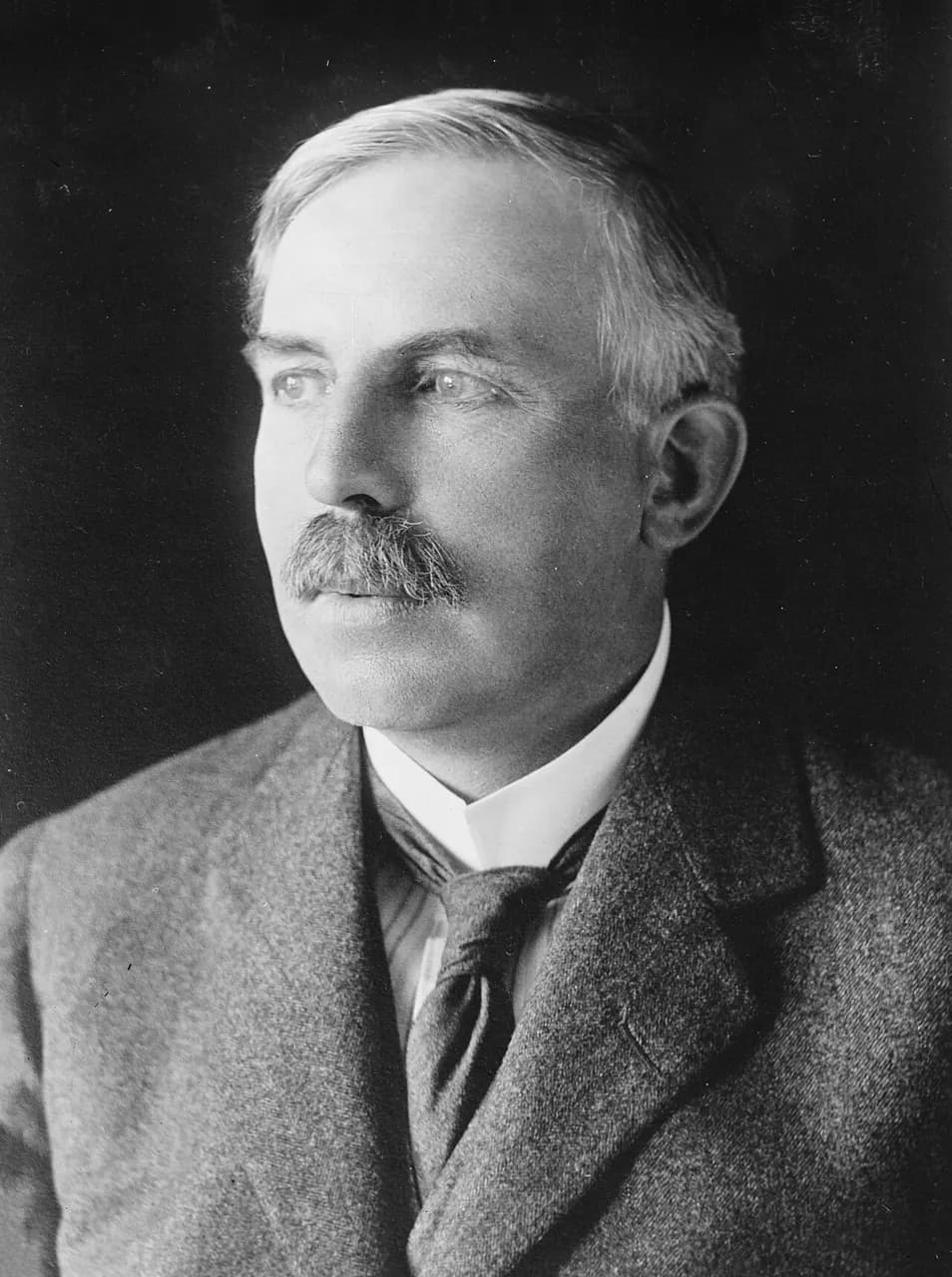
Ernest Rutherford
Physicist, Nobel Prize in Chemistry 1908, father of nuclear physics
Born 1871 · Died 1937
Photo: George Grantham Bain Collection (Library of Congress) · Public domain
«It was almost as incredible as if you fired a 15-inch shell at a piece of tissue paper and it came back and hit you.»
Ernest Rutherford discovered that atoms have a tiny dense nucleus, by firing alpha particles at gold foil and finding that a few bounced straight back. He later achieved the first artificial nuclear reaction, effectively splitting the atom.
Key achievements
- Discovered the atomic nucleus, 1911
- Nobel Prize in Chemistry, 1908, for radioactive decay
- Achieved the first artificial nuclear reaction, 1917
Universities
Manchester
Professor of physics from 1907 to 1919, where he discovered the atomic nucleus and first split the atom.
Cambridge, England
Studied at the Cavendish Laboratory from 1895 and returned as its director in 1919.
Montreal, Quebec
Professor of physics from 1898 to 1907, where he did the radioactivity work that won him the Nobel Prize.
Facts
- He compared the gold foil result to firing a fifteen-inch shell at tissue paper and having it come back at you.
- He won the Nobel Prize in Chemistry, not Physics, and regarded it as a joke since he considered chemistry a lesser science.
- Eleven of his students and colleagues went on to win Nobel Prizes themselves.
Photographs
Photographs come from Wikimedia Commons under free licences; the author and licence are shown on each image.