
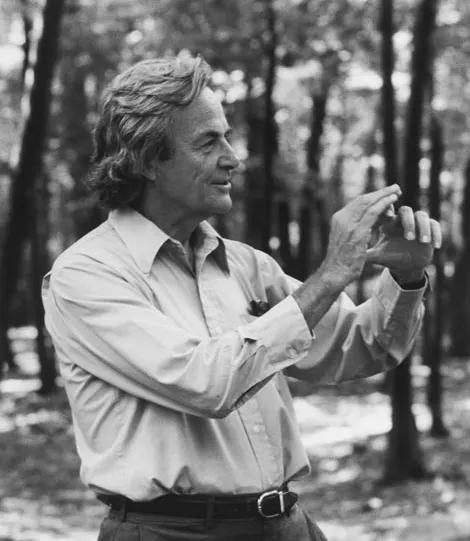
Richard Feynman
Physicist, Nobel Prize in Physics 1965
Born 1918 · Died 1988
Photo: Copyright Tamiko Thiel 1984 · CC BY-SA 3.0
«The first principle is that you must not fool yourself — and you are the easiest person to fool.»
Richard Feynman shared the 1965 Nobel Prize for quantum electrodynamics and invented the Feynman diagrams that physicists use to picture particle interactions. A safecracker, bongo player and unrivalled lecturer, he became the most popular scientist of his era through his memoirs and the Feynman Lectures on Physics.
Key achievements
- Nobel Prize in Physics, 1965, for quantum electrodynamics
- The Feynman Lectures on Physics, still taught worldwide
Universities
Cambridge, Massachusetts
SB in physics, 1935–39; began in mathematics, tried electrical engineering, then settled on physics; Putnam Fellow in 1939.
Princeton, New Jersey
PhD in 1942 under John Wheeler; scored a perfect mark in physics on the entrance examination.
Pasadena, California
Professor of theoretical physics from 1950 until his death; his Feynman Lectures on Physics (1961–63) are still in print.
Facts
- At MIT he started in mathematics, found it too abstract, tried electrical engineering and settled on physics; in 1939 he was among the top five scorers in the Putnam mathematics competition.
- His Princeton entrance examination in physics was a perfect score, something the graduate school had never seen, but his poor marks in history and English worried the admissions committee.
- At Los Alamos he worked on the atomic bomb and amused himself by cracking the safes and filing cabinets that held the project's secrets.
- In 1986, on the commission investigating the Challenger disaster, he showed on live television that the rocket's rubber O-rings lost their elasticity in a glass of iced water.
Photographs
Photographs come from Wikimedia Commons under free licences; the author and licence are shown on each image.