
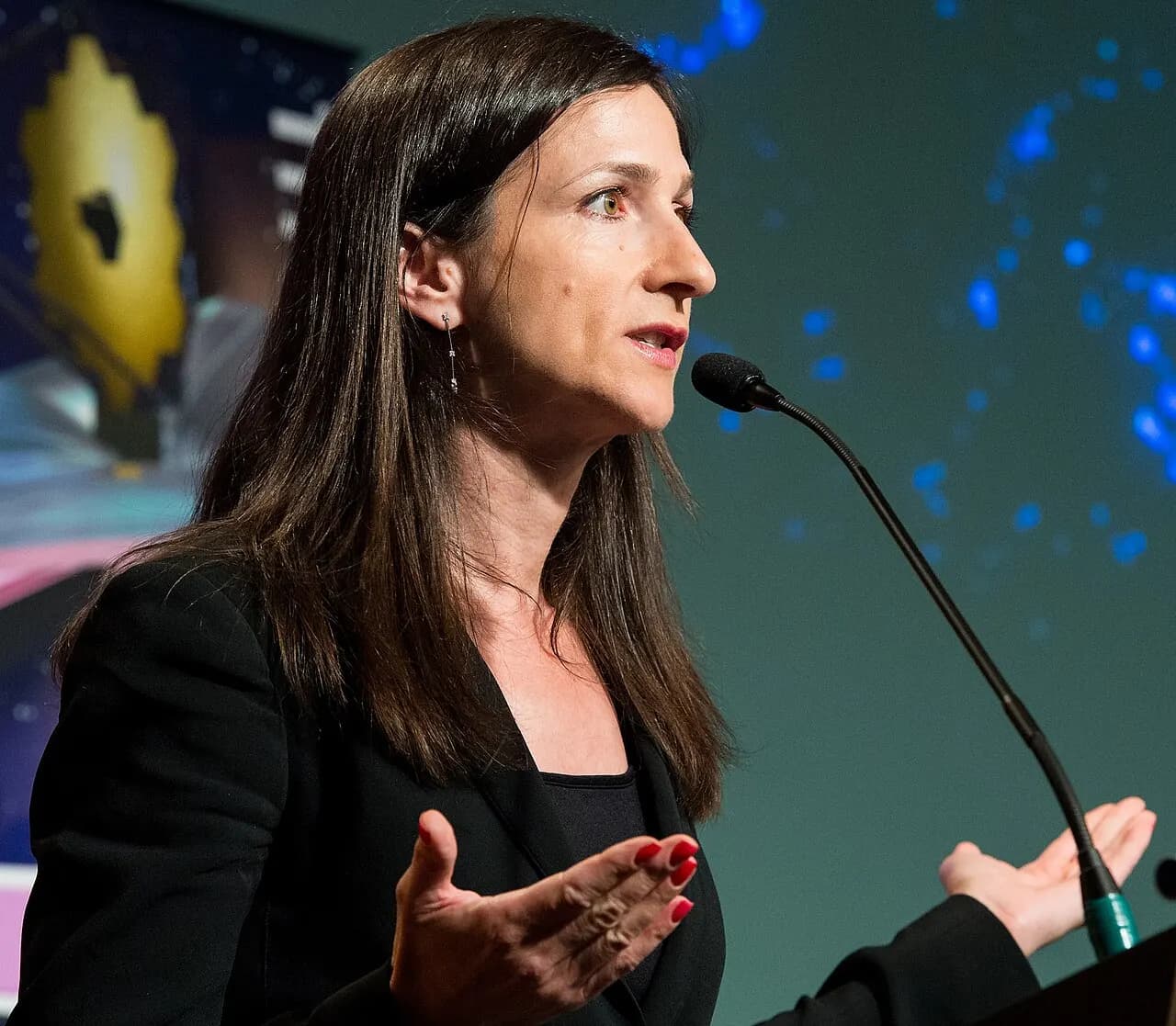
Sara Seager
Astrophysicist, pioneer of exoplanet atmospheres
Born 1971
Photo: Joel Kowsky · Public domain
Sara Seager works out how to read the atmosphere of a planet orbiting another star from the faint light that passes through it, looking for gases that only life could produce. Her doctoral thesis was written when no exoplanet atmosphere had ever been observed.
Key achievements
- Pioneered the theory of exoplanet atmospheres
- MacArthur Fellowship, 2013
- Member of the US National Academy of Sciences
Universities
Cambridge, Massachusetts
Took her PhD in astronomy in 1999 with the first theoretical work on what exoplanet atmospheres would look like.
Cambridge, Massachusetts
Professor of planetary science, physics and aerospace engineering, leading searches for habitable worlds.
Toronto, Ontario
Took her bachelor's degree in mathematics and physics in 1994.
Facts
- The Seager equation, her version of the Drake equation, estimates how many planets with detectable signs of life we might find.
- She was awarded a MacArthur fellowship, the so-called genius grant, in 2013.
- Her memoir The Smallest Lights in the Universe describes rebuilding her life and her science after her husband's death.
Photographs
Photographs come from Wikimedia Commons under free licences; the author and licence are shown on each image.